

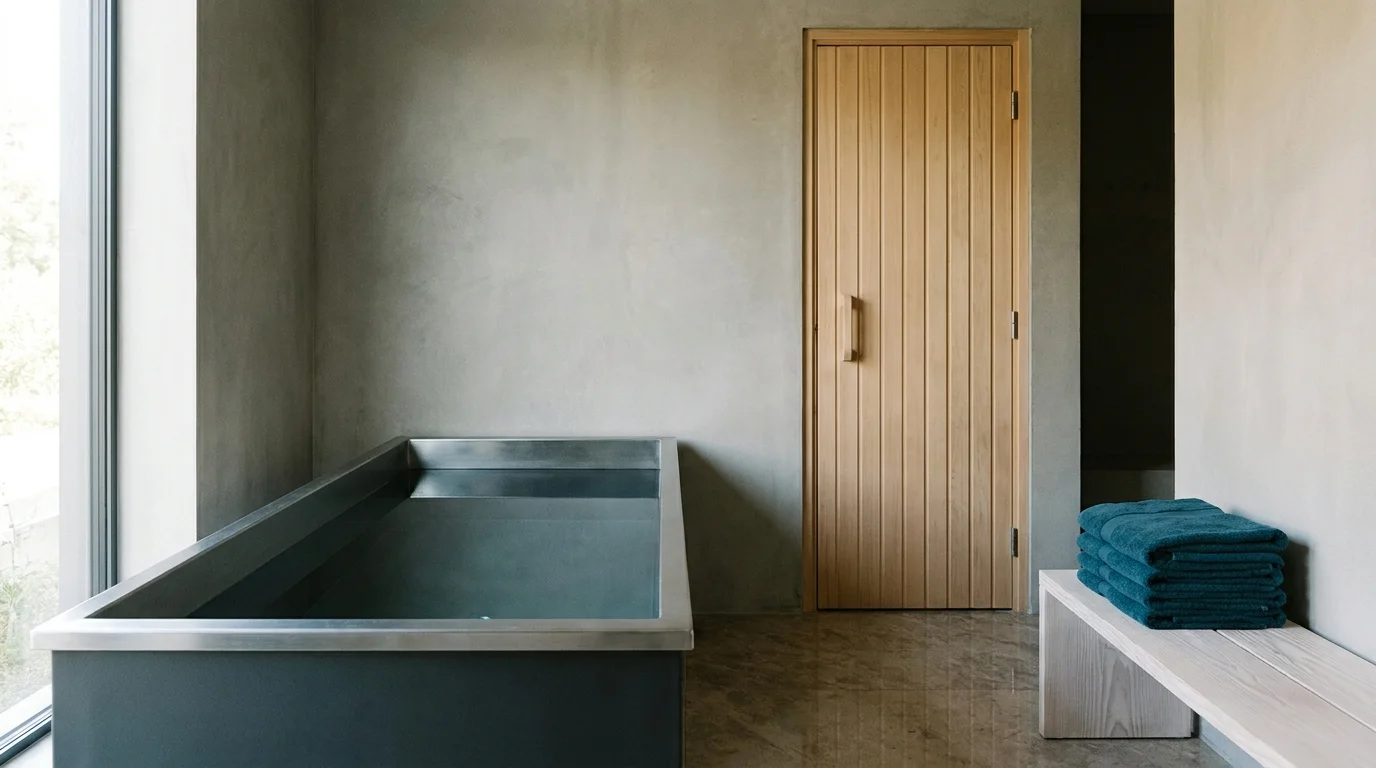
Cold plunge therapy has gone from fringe biohack to mainstream recovery tool in about five years — and most of what's written about it online is either pure marketing or pure hype. This guide is what we tell members at our Santa Clara studio: what cold plunging actually does inside your body, what the published evidence supports (and what it doesn't), the protocols that work, and who shouldn't do it without clearing it with a doctor first.
What "cold plunge" actually means
A cold plunge is brief, full-body immersion in cold water — typically 50–59°F (10–15°C) for 1–5 minutes. The terms cold plunge, cold-water immersion, and ice bath are often used interchangeably, but the research literature usually reserves "ice bath" for water below 50°F that contains actual ice, and uses "cold-water immersion" for the broader category.
What separates a cold plunge from, say, a cool shower is the combination of cold temperature, full-body coverage, and sustained duration. Those three together trigger a coordinated response across the cardiovascular, endocrine, and nervous systems that a shower simply doesn't replicate.
Most clinical studies on cold-water immersion fall in the 11–15°C range. Studies in human thermoregulation show that the largest physiological effects appear once water temperature drops below about 15°C and immersion lasts at least one minute — the threshold at which the cold-shock response, peripheral vasoconstriction, and sympathetic nervous system activation all engage together.
The science: what 38°F water does inside your body in three minutes
Three things happen, roughly in sequence.
1. The cold-shock response (first 30 seconds)
The moment cold water hits skin, peripheral cold receptors fire and trigger an involuntary gasp, a sharp increase in breathing rate, and a spike in heart rate and blood pressure. This is the cold-shock response, and it's the most physiologically demanding moment of a cold plunge. Foundational research from Tipton has shown that this response is also the moment of highest cardiovascular risk — which is why we screen for cardiac history before anyone gets in the tub.
The reflexive gasp is the part you have to work past. Controlled, slow nasal breathing is the single most effective tool for getting through it. Most members find the gasp impulse fades within about 20–30 seconds.
2. Vasoconstriction and the norepinephrine surge (30 seconds to 2 minutes)
As immersion continues, blood vessels in your skin and limbs constrict sharply, shunting blood toward the core. At the same time, the sympathetic nervous system releases norepinephrine — a neurotransmitter and hormone involved in alertness, focus, and mood. Published data on plasma norepinephrine shows roughly a 2–3× rise above baseline during cold immersion at 14°C, an effect that persists for an hour or more after exit.
This norepinephrine surge is the pharmacological mechanism behind the well-known post-plunge mood lift. It is not placebo. It is not vibes. It is a measurable neuroendocrine response.
3. Recovery, brown fat, and vagal tone (after exit)
After you exit, blood returns to the periphery, core temperature recovers, and a different set of effects kick in. Research on brown adipose tissue shows that repeated cold exposure activates and expands brown fat, which burns energy to generate heat. Over weeks of regular practice, parasympathetic recovery improves — measurable as increased vagal tone on heart-rate variability monitors.
That improved vagal tone is one of the most interesting under-discussed benefits, because it links cold plunging to better sleep, faster recovery between training sessions, and lower resting stress.
Cold plunge benefits — graded by evidence
Most articles on cold plunging treat all benefits as equally proven. They aren't. Here's an honest evidence grade based on the published literature.
Strong evidence
- Reduced post-exercise muscle soreness. A Cochrane systematic review of 17 trials found cold-water immersion produced moderate reductions in delayed-onset muscle soreness compared to passive recovery.
- Acute mood improvement. The norepinephrine and dopamine response is well-documented across multiple human studies.
- Cardiovascular and respiratory adaptation. Repeated exposure reduces the magnitude of the cold-shock response over time — the body learns to tolerate it.
Moderate evidence
- Improved sleep quality. Multiple smaller studies and consistent member reports support this, but large RCTs are limited.
- Reduced systemic inflammation markers (CRP, IL-6) after acute exercise.
- Improved insulin sensitivity with regular cold exposure, likely via brown-fat activation.
Weak or mixed evidence
- Long-term immune function. Often claimed, but the evidence base is small and short-term.
- Fat loss. The brown-fat metabolic boost is real but modest. Cold plunging is not a weight-loss tool.
- Strength and hypertrophy gains. Cold immersion after resistance training may actually blunt muscle protein synthesis. If your goal is hypertrophy, plunge on rest days, not immediately post-lift.
Popular but unproven
Claims about lymphatic drainage, "deep cellular detox," and curing depression are not well-supported. We don't make them. If a wellness brand tells you cold water cures something specific and chronic, ask for the citation.
Contrast therapy: why we pair sauna and cold plunge together
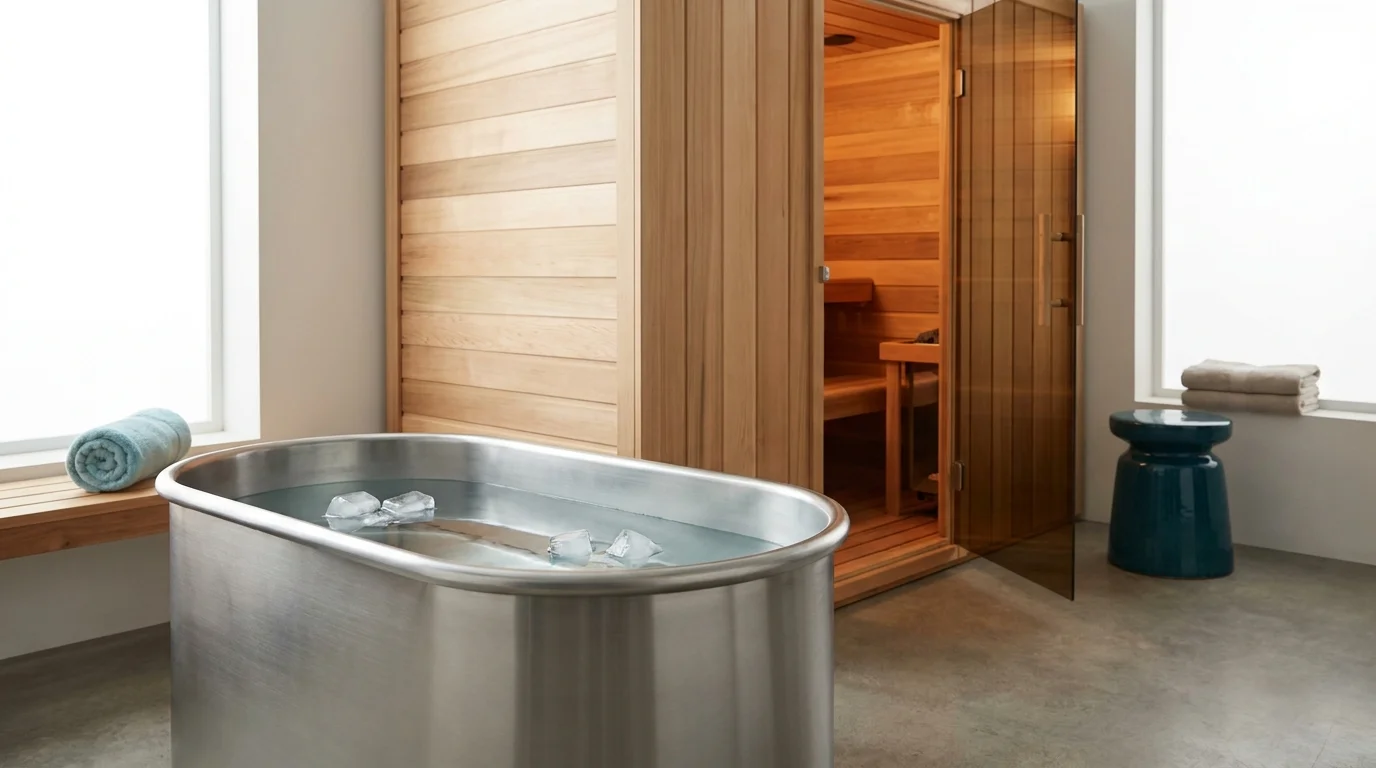
Contrast therapy alternates heat and cold exposure in cycles. The classic protocol — sauna for 12–15 minutes, then 1–3 minutes in the cold plunge, repeated three times — is grounded in cardiovascular physiology. Heat dilates blood vessels and dumps heat to the periphery; cold constricts them and shunts blood centrally. Cycling between the two creates a vascular pumping effect.
A systematic review of contrast water therapy found small but consistent improvements in markers of recovery from exercise compared to either modality alone. The effect sizes are modest, but the safety profile is excellent and the perceived recovery benefit is large enough that most athletes who try it adopt it permanently.
At our studio we run contrast therapy as a member ritual: three rounds of dry sauna sessions at roughly 175–185°F paired with our cold plunge between rounds. Most members exit lighter, sharper, and noticeably less sore the day after a hard training session.
Cold plunge protocols: how long, how cold, how often
The protocol question gets endless online debate. The published research actually converges on a fairly narrow set of answers.
Temperature
The bulk of the human research uses water in the 50–59°F (10–15°C) range. That window produces robust physiological responses without crossing into territory where cold-shock risk rises sharply. Going colder (mid-30s°F) is not necessary for the benefit and is not safer.
Duration
For experienced practitioners, the typical session is 2–3 minutes at 50–59°F. Beginners should start at 30–60 seconds and add 15–30 seconds per session as tolerance builds. Sessions longer than five minutes add diminishing returns and increase the risk of after-drop — when core temperature continues falling for 20–40 minutes after exit.
Frequency
Most members notice meaningful changes in mood, sleep, and post-training recovery with two to four sessions per week. Daily plunging is fine if your body tolerates it, but the dose-response curve flattens above three to four sessions. More is not better.
Time of day
Morning plunging tends to amplify the alerting effect of the norepinephrine surge — useful for clarity, less useful for sleep. Evening plunging is generally fine for most people but avoid it within two hours of bedtime if you find it makes you wired.
Breathing
Slow nasal breathing is the single most useful skill. The reflexive gasp tries to make you breathe fast and shallow; doing the opposite — slow, controlled exhales — calms the cold-shock response within 20–30 seconds.
Who should not cold plunge (or should clear it with a doctor first)
This is the section most online cold-plunge content skips. We screen every new member, because the cold-shock response is genuinely dangerous for some people.
Talk to your doctor before cold plunging if you have:
- Uncontrolled high blood pressure or a recent change in blood-pressure medication
- A history of heart attack, stroke, or arrhythmia
- Severe Raynaud's phenomenon
- Cold urticaria (a skin allergy to cold)
- Pregnancy (the data is limited, so most clinicians recommend caution)
- Open wounds or active skin infections
- Peripheral vascular disease
Avoid cold plunging entirely if you have a known cold-induced arrhythmia, severe coronary artery disease, or a history of cold-water shock or near-drowning. Never cold plunge alone if you have a seizure disorder.
None of this means cold plunging is dangerous for healthy adults. It isn't. It does mean the screening matters, which is why we ask the questions on intake.
Cold plunge in San Jose: what we run at BMS Wellness
Our cold water immersion setup at the Santa Clara studio runs at 38–42°F — the colder end of the standard wellness range. We chose that band deliberately: cold enough to drive a strong sympathetic response, warm enough to keep the after-drop manageable for the average member.
Our protocol for new members:
- Visit 1: 60 seconds. Coach in the room. We focus on breath control more than time.
- Visit 2: 90 seconds.
- Visit 3: 2 minutes — the standard adult dose.
- Visit 4 onward: 2–3 minutes, optionally paired with sauna for full contrast therapy.
The cold plunge sits inside a recovery suite that includes our infrared sauna, red light therapy, and PEMF therapy — so most members stack modalities into a 60–90 minute recovery block rather than treating cold as a one-off. Membership options include unlimited contrast therapy access; drop-in single sessions are also available.
Common mistakes (and how to fix them)
The mistakes we see in clients who've been cold-plunging on their own:
- Going too cold, too fast. 33°F for five minutes on day one is not "discipline" — it's a stress test that produces a worse outcome than the same person doing 50°F for two minutes. Build up.
- Holding your breath. The body interprets breath-holding plus cold as a serious threat. Breathe slow, breathe out longer than in.
- Cold immediately after heavy strength training. If your goal is hypertrophy, wait at least four hours, or plunge on a rest day.
- Skipping the post-plunge rewarming. Light movement after exit (walking, gentle squats) helps blood return to the periphery and reduces the after-drop. Don't just stand still.
- Treating it as a contest. Longer is not better. Colder is not better. Consistency is what compounds.
If you've been on a self-directed protocol and want a sanity check, our team is happy to walk through it. Free 15-minute consultations are open to anyone — book a consultation and we'll review what you're doing.
The bottom line
Cold plunging is one of the few wellness practices where the underlying physiology is well-understood, the short-term benefits are reliably reproducible, and the long-term safety profile is excellent for healthy adults. It's also one where the marketing has gotten well ahead of the evidence in places — fat loss, "detox," chronic disease cures — and where the protocol that works is genuinely simple: 50–59°F, two to three minutes, two to four times a week, paired with sauna if you have access to one.
The framework that matters most is hormesis — the principle that small, controlled stressors make a system more resilient over time. Cold plunging is one of the cleanest hormetic tools available outside of exercise itself. Used consistently, screened properly, and stacked thoughtfully with heat and recovery work, it earns its place in a modern wellness routine.
If you want to try it under supervision in the South Bay, the cold plunge at our studio is open to members and drop-ins — and our team will walk you through your first session start to finish.