
Contrast therapy — alternating cycles of sauna and cold plunge — is one of the most reliable recovery tools we run at our Santa Clara studio. Most of what's written about it online treats it as either a fringe biohack or a single-cycle dunk. The actual protocol is more specific than that, the physiology is well-documented, and the difference between doing it well and doing it casually is the difference between a recovery tool that works and one that doesn't. This is what we tell members.
What contrast therapy actually is
Contrast therapy is the cyclical alternation of heat exposure — typically a dry or infrared sauna — with cold immersion, repeated for several rounds in a single session. The classic recovery protocol is three rounds of 10–15 minutes hot followed by 1–3 minutes cold, with brief rest between rounds. Total session length is around 45–60 minutes including transitions.
The terms contrast therapy, contrast bath therapy, and contrast water therapy are sometimes used interchangeably; the published clinical literature most often uses contrast water therapy when both phases are immersion-based, and contrast therapy more broadly when the heat phase is sauna or steam.
What separates contrast therapy from doing each modality on its own is the cycling. Single-modality sauna and single-modality cold plunge each produce real but distinct effects. The cycle creates a third effect — a vascular pumping action and an autonomic switch — that neither does alone. If you've already read our companion piece on cold plunge protocols in San Jose, this post is the layer above it: the cold plunge is one of two modalities in the cycle, and the cycle is what changes the response.
The physiology: vascular pumping and autonomic switching
Two parallel mechanisms make contrast therapy more than the sum of its parts.
1. The vascular pumping effect
Heat dilates blood vessels and shifts blood toward the periphery to dump heat. Cold constricts those same vessels and shunts blood toward the core. Cycling between the two creates rapid, repeated changes in peripheral blood flow — what some clinicians call a vascular pump. The pumping appears to assist clearance of metabolic byproducts from working muscle.
A systematic review and meta-analysis of contrast water therapy compared contrast cycling to passive recovery and to single-modality cold-water immersion after exercise-induced muscle damage. Contrast therapy produced small but consistent improvements in markers of recovery — strength return, perceived soreness, and biochemical indicators — beyond what either modality produced alone.
2. Autonomic switching: from sympathetic to parasympathetic
The hot phase pushes the cardiovascular and nervous systems toward sympathetic activation — heart rate up, vessels open, sweating increased. The cold phase elicits a sharp sympathetic spike on entry, then yields to a parasympathetic rebound on exit. Multiple cycles repeatedly stress and rebalance the autonomic nervous system.
Over weeks of regular practice, the parasympathetic recovery improves measurably on heart-rate variability monitors. Members frequently describe better sleep, lower resting stress, and faster recovery between training sessions, which is consistent with what improved vagal tone produces in the published research.
3. The hormetic frame
Both heat and cold are mild, controlled stressors. Used briefly and repeatedly, they trigger adaptations that make a system more resilient — the principle of hormesis. Contrast therapy is one of the few practices that delivers two complementary hormetic stresses in a single session, and the research on each modality individually has shown reliable physiological adaptation over weeks of consistent use.
Sauna first or cold first?
Both orders are common, both are valid, and the order genuinely changes the outcome.
Sauna first, ending on cold
The most studied protocol. Heat in the sauna drives vasodilation and a sympathetic warm-up; the final cold round triggers a sharp norepinephrine and adrenaline release. The classic Šrámek dataset on cold-water immersion at 14°C documented plasma norepinephrine elevations of roughly 530% above baseline — a measurable neuroendocrine spike, not a marketing line. The result is a more alert, sympathetically-toned end state — useful before work, training, or any session that benefits from clarity and energy.
Sauna first, ending on warm
Same cycle structure, but reverse the final round so the session closes with a brief warm sit rather than a final cold plunge. The cold plunge is still in the protocol — typically 1–3 cold immersions earlier in the session — but the final exposure is heat. The result is a parasympathetically-toned end state — useful in the evening or before sleep.
Cold first
Less commonly used as a recovery protocol but reasonable for some applications. Starting on cold delivers the cold-shock and norepinephrine spike at the front of the session, which some athletes find useful for nervous-system priming before training. We don't generally recommend cold first for recovery purposes; the vascular-pumping effect is more pronounced when sauna leads.
The practical rule
Pick based on what comes next in your day. Ending on cold is alerting; ending on warm is relaxing. Either is consistent with the published recovery research; the order is the variable, the cycling is the principle.
Contrast therapy benefits — graded by evidence
Most articles treat all contrast therapy benefits as equally proven. They aren't. Here's an honest evidence grade.
Strong evidence
- Reduced delayed-onset muscle soreness after intense exercise. The Bieuzen meta-analysis documented small but consistent improvements over passive recovery.
- Faster perceived recovery between training sessions. A comprehensive review of water immersion recovery found contrast water therapy reliably outperforms passive rest.
- Cardiovascular adaptation with regular use. Repeated heat exposure is a well-documented cardiovascular conditioning stimulus. The Laukkanen 2015 prospective cohort followed 2,315 middle-aged Finnish men for a median of 20.7 years and found that 4–7 sauna sessions per week was associated with a roughly 40% lower all-cause mortality compared to one session per week. The signal is association, not causation, but the cohort size and follow-up duration are unusually robust for a sauna study.
- Acute mood improvement. The norepinephrine and dopamine response of the cold phase is well-documented across multiple human studies.
Moderate evidence
- Improved parasympathetic tone with regular practice. Heart-rate variability data across small studies and consistent member reports support this.
- Improved sleep quality. Multiple smaller studies and consistent self-report data support an effect; large RCTs are limited.
- Reduced perception of stress and improved cognitive clarity in the hours after a session.
Weak or mixed evidence
- Long-term immune function. Often claimed; the evidence base is small and short-term.
- Significant fat loss. The brown-fat and metabolic responses are real but modest. Contrast therapy is not a weight-loss tool.
- Specific disease prevention claims beyond the cardiovascular cohort signal — be cautious of any provider promising contrast therapy will cure or prevent specific chronic conditions.
Protocols: cycles, durations, temperatures
Sauna phase
Dry sauna at 175–195°F (80–90°C), infrared sauna at 130–150°F (55–65°C). The cardiovascular and physiological literature on sauna bathing is built on the dry sauna range; infrared is a milder variant with overlapping but less robust evidence.
Duration: 10–15 minutes per round. Beginners should start at 8–10 minutes and build. Going longer than 20 minutes per round adds little benefit and increases risk of orthostatic light-headedness on standing.
Cold phase
Cold plunge at 50–59°F (10–15°C) is the most studied range; many wellness studios run colder (38–45°F) for a stronger sympathetic response. Foundational human thermoregulation studies set the dose-response curve in the 50–59°F band.
Duration: 1–3 minutes per round. Sessions longer than three minutes add diminishing returns and increase the risk of after-drop in core temperature.
Cycle structure
The most used recovery protocol is three rounds of sauna-then-cold, with 3–5 minutes of seated rest between rounds. Total session length is around 45–60 minutes.
Frequency
Two to four sessions per week produces meaningful recovery and autonomic-tone changes for most members. Daily contrast is fine if your body tolerates it; the dose-response curve flattens above three to four sessions per week.
Breathing
Slow nasal breathing in the cold is the single most useful skill. The reflexive cold-shock response tries to make you breathe fast and shallow; doing the opposite — slow, controlled exhales — calms the response within 20–30 seconds.
Contrast therapy after exercise: timing matters
One of the few places the cold-water research disagrees with itself is around resistance training. High-quality work from Roberts and colleagues showed that cold-water immersion immediately after strength training can blunt acute anabolic signaling and reduce long-term muscle hypertrophy adaptations.
What that means in practice:
- If your goal is recovery between training sessions — contrast therapy is reliably useful. Soreness comes down, perceived recovery improves, and the cardiovascular and autonomic adaptations compound.
- If your goal is hypertrophy from heavy resistance training — wait at least four hours after lifting before doing the cold portion of contrast therapy, or schedule contrast on rest days. The sauna alone, without the cold phase, is fine immediately post-lift.
- If your goal is endurance training recovery — the published evidence does not show the same blunting effect for endurance adaptations as for hypertrophy. Contrast therapy after endurance work is fine and arguably useful.
This is one of the most overlooked nuances in the wellness-marketing version of contrast therapy. The protocol that works for endurance recovery is not the protocol that works for hypertrophy training.
Who should not do contrast therapy
Both heat and cold are real cardiovascular stimuli. The screening list matters.
Talk to your doctor before contrast therapy if you have:
- Uncontrolled high blood pressure or a recent change in blood-pressure medication
- A history of heart attack, stroke, or arrhythmia
- Severe Raynaud's phenomenon
- Cold urticaria (a skin allergy to cold)
- Pregnancy — the data on heat exposure during pregnancy is limited, and most clinicians recommend caution; the cold component carries less clear data
- Open wounds or active skin infections
- Recent surgery
- Peripheral vascular disease
- Pulmonary insufficiency or severe COPD
Avoid contrast therapy entirely if you have a known cold-induced arrhythmia, severe coronary artery disease, or a history of cold-water shock or near-drowning. Never do the cold phase alone if you have a seizure disorder.
None of this means contrast therapy is dangerous for healthy adults. It isn't. It does mean the screening matters.
Contrast therapy in San Jose: the BMS recovery suite
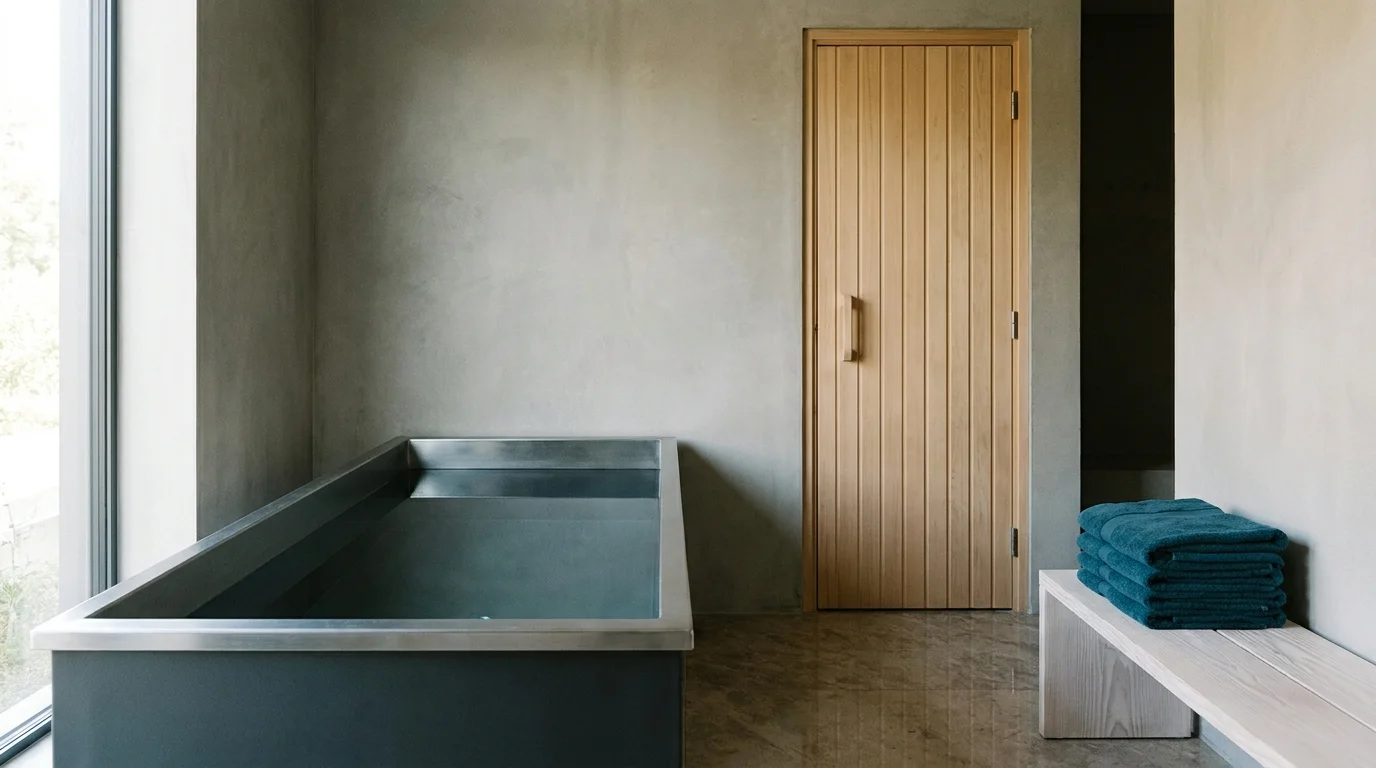
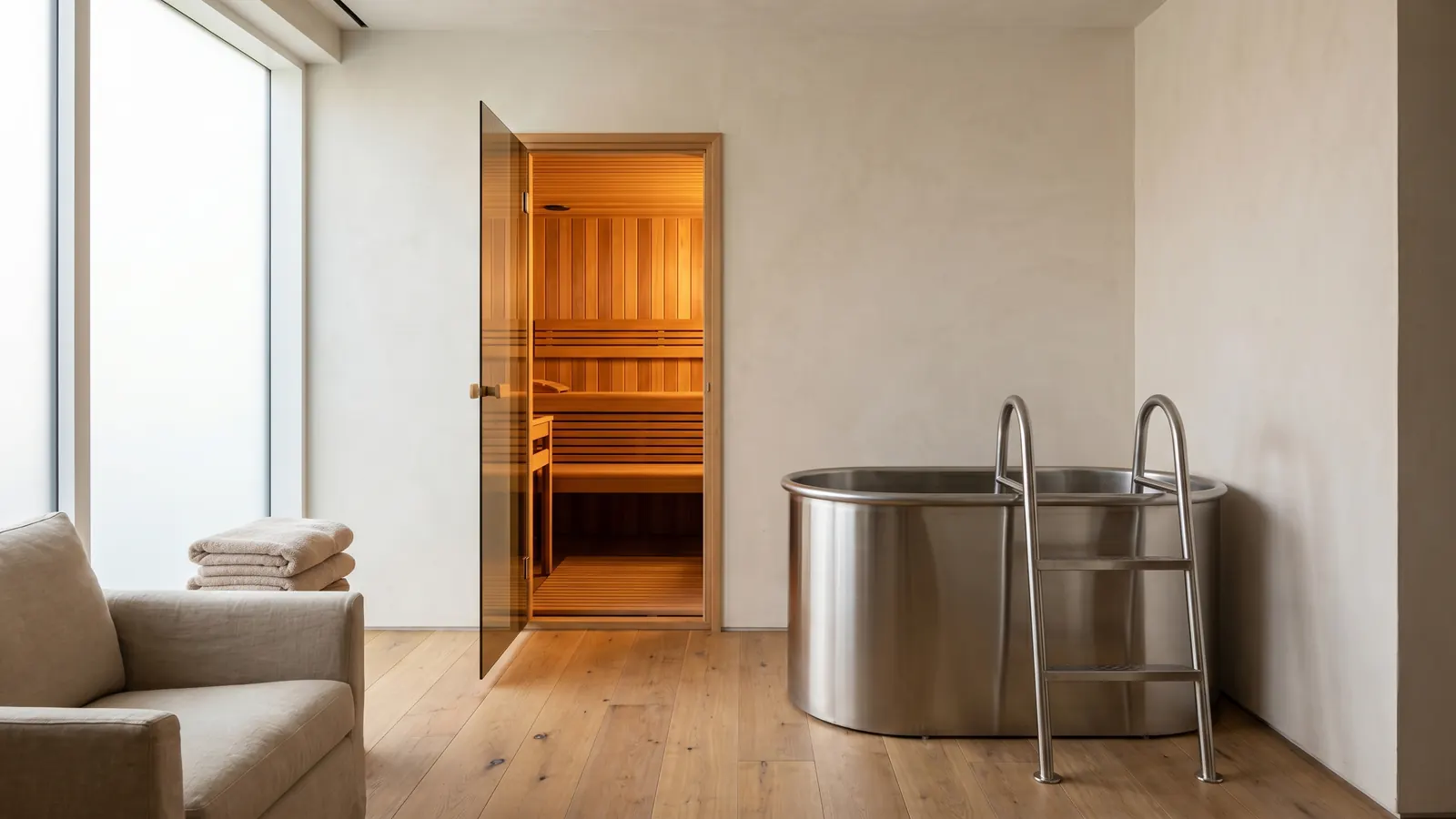
Our recovery suite at the studio is built specifically for contrast therapy. The dry sauna runs at 175–185°F. The cold plunge runs at 38–42°F — at the colder end of the standard wellness range, deliberately chosen to drive a strong sympathetic response while keeping after-drop manageable for the average member.
The two units sit adjacent to one another with a transition bench between, so transit time is under 20 seconds. That short transit matters for the vascular pumping effect; long walks between the sauna and the cold blunt the cycle.
Our standard 60-minute contrast block:
- Round 1: 12 minutes sauna, 60 seconds cold plunge.
- Rest: 3–5 minutes seated, water and breath recovery.
- Round 2: 12–15 minutes sauna, 90 seconds cold plunge.
- Rest: 3–5 minutes.
- Round 3: 12–15 minutes sauna, 1–2 minutes cold plunge.
- Close: brief rewarming, hydration, light movement.
Most members stack contrast therapy with our red light therapy, PEMF therapy, or hyperbaric oxygen therapy in the same visit — building a 90–120 minute recovery block once or twice a week. Membership options include unlimited contrast therapy access; drop-in single sessions are also available.
Common mistakes (and how to fix them)
The mistakes we see in members who've been doing contrast therapy on their own:
- Skipping the cycles. One round of sauna and one cold plunge is not contrast therapy — it's a sauna with a cold plunge afterward. The pumping effect requires three cycles.
- Going too cold, too fast. 33°F for five minutes on day one is not discipline — it's a stress test that blunts the protocol. Build the cold tolerance over a few sessions.
- Holding your breath in the cold. The body interprets breath-holding plus cold as a serious threat. Breathe slow, breathe out longer than in.
- Cold immediately after heavy strength training. If your goal is hypertrophy, wait at least four hours, or do contrast on a rest day.
- Underhydrating. Sauna sweats are real. Drink water before, between rounds, and after.
- Treating it as a contest. Longer in the sauna isn't better. Colder isn't better. Consistency is what compounds.
If you've been on a self-directed protocol and want a sanity check, our team is happy to walk through it. Free 15-minute consultations are open to anyone — book a consultation and we'll review what you're doing.
The bottom line
Contrast therapy is one of the cleanest recovery tools available outside of training itself. The mechanism is well-understood. The protocol that works is genuinely simple — three cycles of 10–15 minutes hot and 1–3 minutes cold, two to four times a week — and the long-term safety profile is excellent for screened, healthy adults. The published evidence supports its use for muscle recovery and autonomic conditioning; the marketing has, in places, gotten well ahead of what the data supports for specific disease claims.
Used consistently and screened properly, contrast therapy is one of the few wellness practices where doing it right matters more than doing it often. Three good cycles beat ten casual dunks, every time.
If you want to try contrast therapy under supervision in the South Bay, the recovery suite at our studio is open to members and drop-ins — and our team will walk you through your first session start to finish.